

what?
The Equi7Grid is a spatial reference system optimised for gridded raster images and geodata. It provides coordinates and a pixel-cell for each location on the Earth, very similar to typical examples like “Lat-Lon” or UTM grids.
The key feature of the Equi7Grid is that it splits the globe into 7 continental zones, centred on the landmasses. Each of them are projected to a planar map, using an optimal projection for raster images.
➜ See yourself how the grid is set up. Just click on the Earth below!
The software, source geometries, and documentation can be found in our GitHub repository.
what for?
The Equi7Grid is a spatial reference system designed to handle efficiently the archiving, processing, and displaying of high resolution raster image data. It supports geo-datacubes holding large volumes of satellite imagery, as it preserves geometric accuracy and minimises data oversampling over global land surfaces — to a very low value of 3%!
-
designed for high-resolution raster data ideal for satellite and spatial imagery with samplings finer than 1 km
-
minimises data oversampling data inflation is kept small to reduce storage and processing load
-
prevents data loss spatial signal is preserved with high fidelity
-
enables land applications without interruptions eases processing and visualisation activities

why map projections?
Displaying and working with digital spatial data – which are typically handled in form of arrays – sooner or later require a 2D representation. The Equi7Grid picks this up, and simplifies workflows as it realises a simple cartesian gridding right from the beginning, eliminating the need for further transformations or image warping.
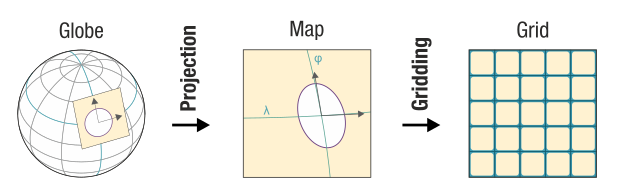
Due the cartesian basis all locations can be directly addressed with orthogonal indices in x and y directions, allowing simple and fast access to array data.
But: Any transformation from our 3-dimensional planet to a 2-dimensional map leads – inevitably – to the distortion of angles, area, or length – in the worst case all of them! Consequently, when ingesting into a projected grid, data is changed or lost to some degree. Learn more on this site's theory page.
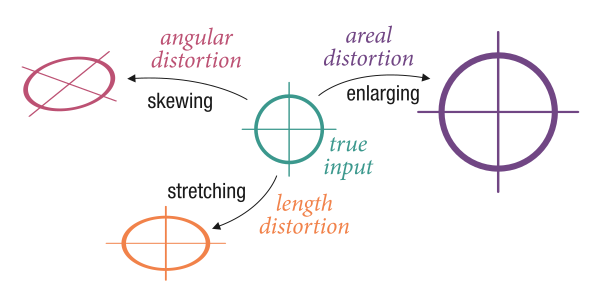
On this background, the name-giving Equidistant Azimuthal projection used in the Equi7Grid has been found favorable when working with raster images. Within this projection only stretching happens (and only in one direction), while neither shortening nor skewing damage the ingested data.
In our study, we've generally found that equidistant projections alter raster data the least, with minimal oversampling (that is: data inflation), while at the same time they obviate any data loss – a problem inherent to equal-area projections.
why splitting into 7 zones?
So, why splitting Earth into 7 zones now? As a simple alternative, global one-piece projections tend to distort data much more than regional maps, and particularly on the periphery the distortions can get severe. Splitting the globe into smaller pieces helps to further reduce map distortions – and to reduce the related damages on the data.
However, systems like UTM, which divide Earth very narrowly into 60 zones to facilitate highest geometric fidelity, bring a new cost: Managing the overhead from navigating and translating between 60 individual data spaces can get cumbersome.
Imagine you want to display a map, let's say, of the entire Spain mainland. Then already you need to align 3 UTM zones! In practice this involves data warping at least from 2 zones.
Our choice on forming 7 zones lets major continental land bodies mostly intact, and aims on common user requirements to work without interruptions within their region of interest.
This allows to keep the level of necessary data manipulation and management low, and most importantly, eases processing and visualisation activities.